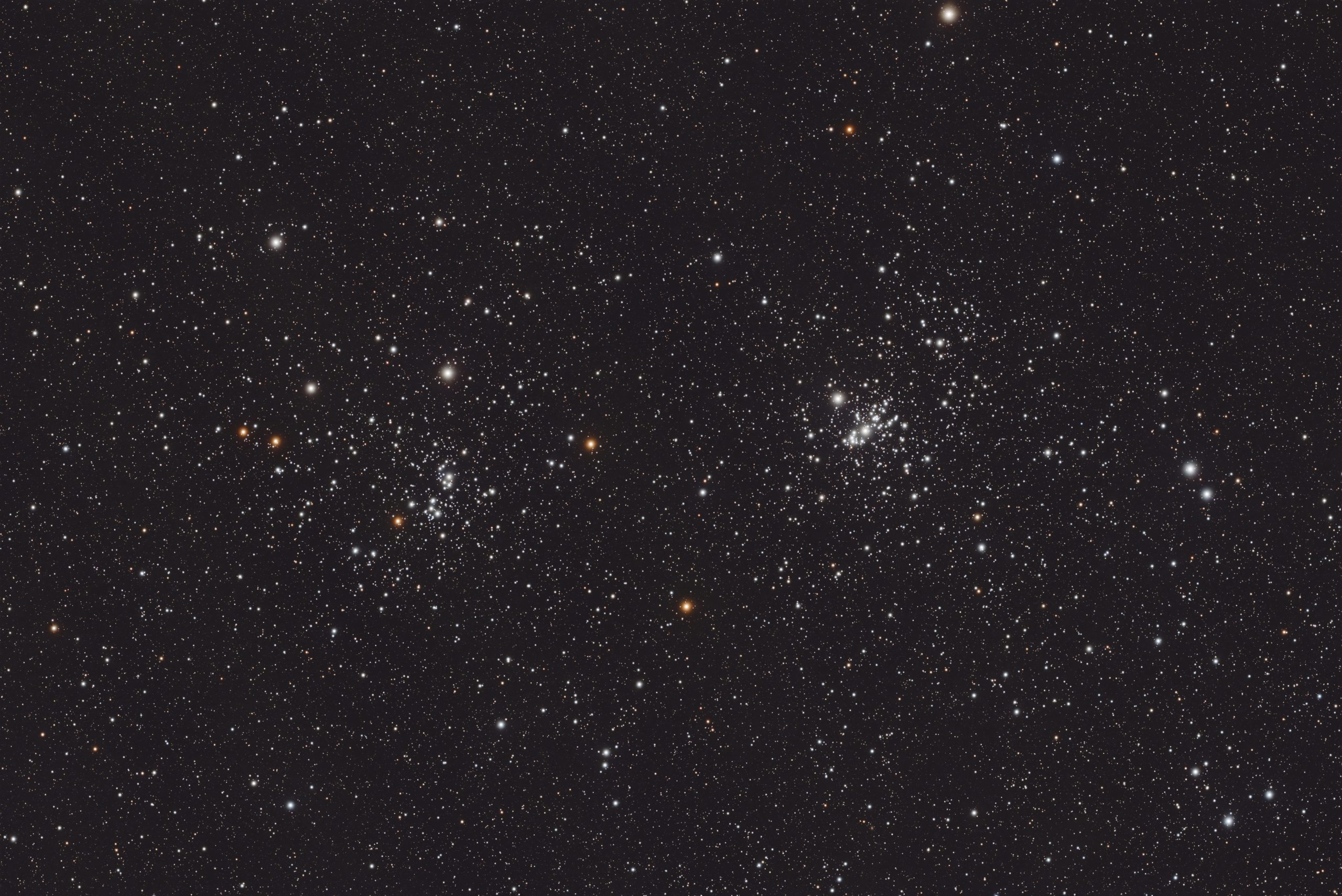
Image Details: 1.5 Hours RGB with 30s sub frames taken with 151PHQ and asi2600mmPro on Losmandy G11
The Double Cluster, also known as Caldwell 14, is a beautiful pair of open star clusters named NGC 869 and NGC 884 that lies in the constellation Perseus. They are easily visible to the naked eye on a clear night as a hazy patch of light between Perseus and Cassiopeia, making them a favorite for both stargazers and amateur astronomers.
Location and Appearance
- The Double Cluster is located about 7,500 light-years away in the Perseus arm of our Milky Way.
- NGC 869 and NGC 884 each contain several thousand stars, including more than 300 blue-white supergiants per cluster, which contribute to their striking color contrast.
- In binoculars or a small telescope, they appear as “two worlds dancing together,” with each cluster displaying a dense core surrounded by a sprinkling of stars.
Science and History
- Both clusters are very young by cosmic standards, only about 14 million years old, and much younger than other well-known clusters like the Pleiades.
- The clusters are separated by just a few hundred light-years and are each around 60 arc-minutes in apparent width, about twice the width of the Full Moon in the sky.
- The Double Cluster has been observed since ancient times—it was first catalogued by the Greek astronomer Hipparchus around 130 BCE.
- The clusters are moving toward us, approaching at around 24 miles per second (approximately 38-39 km/s).
Observing Tips
- The Double Cluster stands out even in light-polluted skies but looks most spectacular from a dark location in autumn and winter.
- Find the W-shaped constellation Cassiopeia, then look halfway along an imaginary line towards Perseus; the clusters will glow as a distinct patch.
- With a telescope, observers can easily resolve the brilliant blue and occasional red supergiant stars in each cluster.
The Double Cluster is a stunning and rich region of the night sky, well worth finding and sharing with family for an inspiring stargazing experience.
