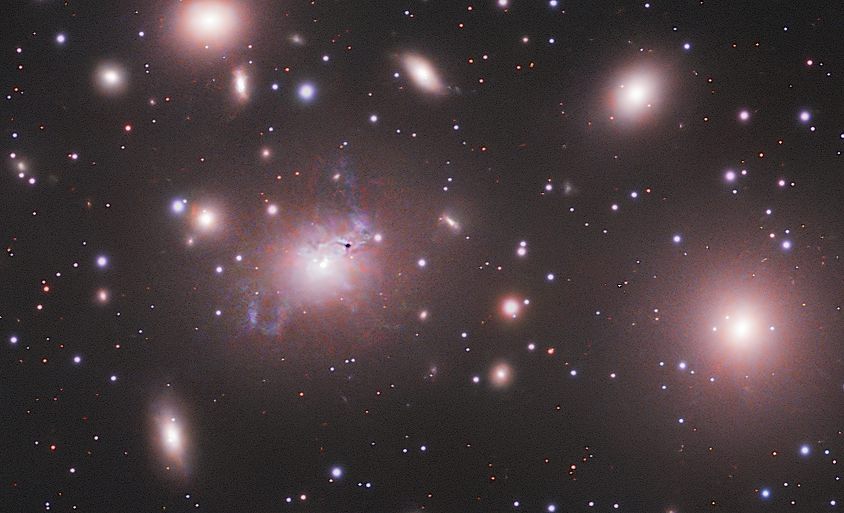
Image details: Data collected at Starkest and Frontenac Festival of stars 2025 with Askar 151PHQ and asi2600mm on a G11
NGC 1275 is a highly active galaxy at the heart of the Perseus Cluster, featuring a luminous active nucleus, a powerful black hole, vast filaments of gas, and star formation processes. NGC 1272, also a member of the Perseus Cluster, is a massive elliptical galaxy recognized for its curved radio jets and depleted interstellar medium.
NGC 1275: Central Perseus Cluster Galaxy
- NGC 1275 (Perseus A) is about 225–250 million light-years away and is the brightest member of the Perseus Cluster.
- Classified as a Seyfert galaxy, it hosts an active galactic nucleus powered by a supermassive black hole (~800 million solar masses).
- The galaxy is surrounded by extensive, reddish filaments of cooler gas (200 light-years wide, up to 20,000–200,000 light-years long), maintained by weak magnetic fields despite surrounding X-ray hot gas.
- It is a strong emitter of both radio waves and X-rays, noted for its relativistic plasma jets and prominent dust lanes from disrupted galaxies.
- NGC 1275 contains about 13 billion solar masses of molecular hydrogen, fueling star formation and feeding its active nucleus.
- Located centrally in the Perseus Cluster (Abell 426), it interacts dynamically with its environment, including a foreground high-velocity galaxy system being stripped by cluster gas.
NGC 1272: Massive Elliptical with Bent Jets
- NGC 1272 is about 226–230 million light-years away, the second brightest galaxy in the cluster after NGC 1275.
- It is a massive elliptical (cD/E+) galaxy with an active galactic nucleus and two prominent radio jets, which are distinctly bent due to ram-pressure as the galaxy moves through the hot intracluster medium.
- Its jets’ curvature and ISM depletion indicate the galaxy’s interaction with cluster gas, with internal AGN feedback and environmental stripping removing most of its interstellar medium.
- The galaxy is estimated to be about 200,000 light-years in diameter with a half-light radius around 36,000 light-years.
- NGC 1272 is surrounded by thousands of globular clusters—around 12,000—showing its large, evolved nature.
Observational Context
- Both galaxies are visually rich members of the Perseus Cluster, positioned close together—their different appearances and physical processes make them targets for studies on galaxy evolution in dense environments.
- NGC 1275 is particularly noted for its energetic displays observable across the spectrum, while NGC 1272 is an example of how cluster interactions strip galaxies of their gas and sculpt their features.
