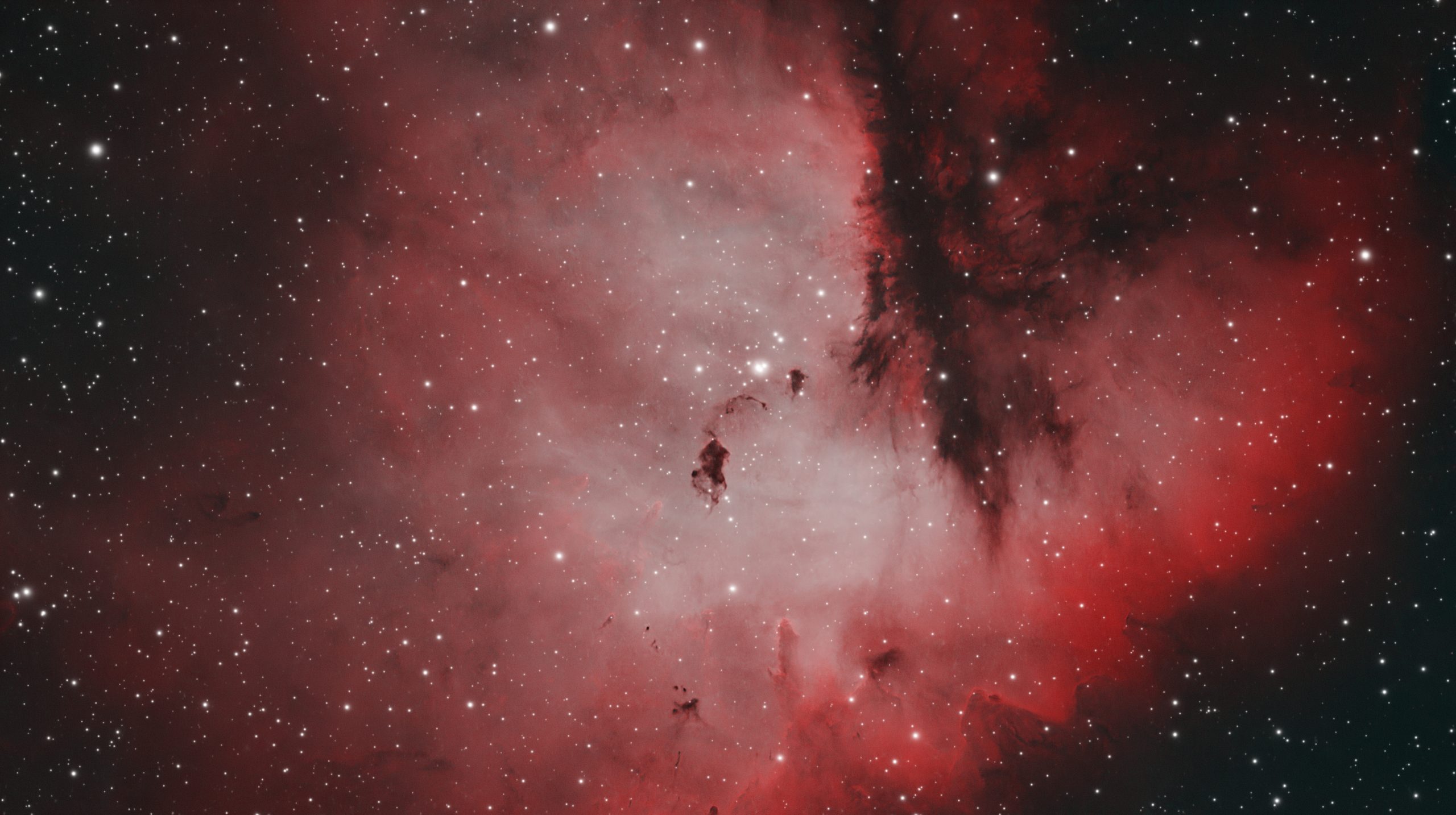
NGC 281, also known as the “Pacman Nebula,” is a prominent emission nebula located in the constellation Cassiopeia and is noted for its detailed fine structures, including dense molecular clouds, intricate dust lanes, and active star-forming regions.
Dense Molecular Clouds
Within NGC 281, there are well-defined clumps of molecular gas and dust that give rise to regions of varying opacity and structure. These molecular clouds are critical for star formation and show filamentary and knot-like features at fine spatial scales.
Dust Lanes and Pillars
The nebula contains several prominent dark dust lanes and pillars that visually divide its bright emission regions. These fine structures are shaped by the intense radiation and stellar winds from newly formed massive stars, which erode and sculpt the surrounding interstellar material into intricate and irregular patterns.
Bok Globules and Star Formation
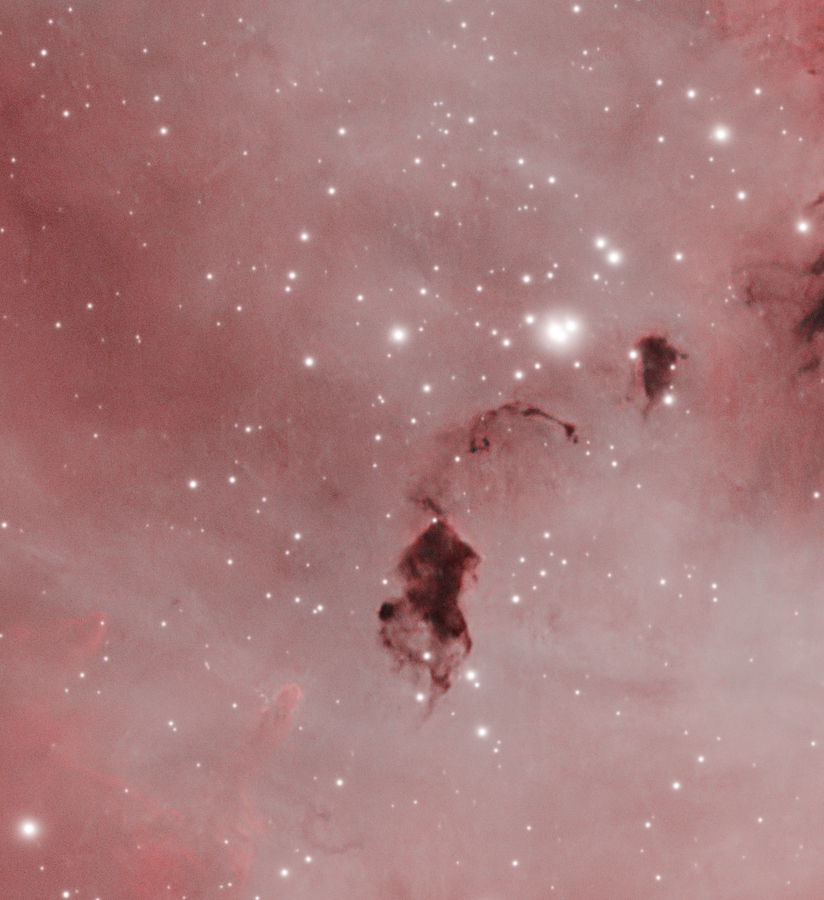
NGC 281 is home to multiple Bok globules—small, dense clouds of gas and dust that often host early-stage star formation. These appear as compact, dark blobs against the brighter backdrop and are critical sites for protostar development.
Herbig-Haro Objects and Ionization Fronts
The region is known for fine features such as Herbig-Haro objects, which are jets of material ejected from young stars colliding with the surrounding nebular gas. Ionization fronts, where the gas is sharply energized by ultraviolet radiation, create intricate boundaries and highlight small-scale structures throughout the nebula.
Fine Filaments and Clusters
The nebula exhibits fine networks of ionized gas filaments and contains the young open cluster IC 1590, whose massive stars contribute to sculpting the surrounding nebula and its detailed internal features.
