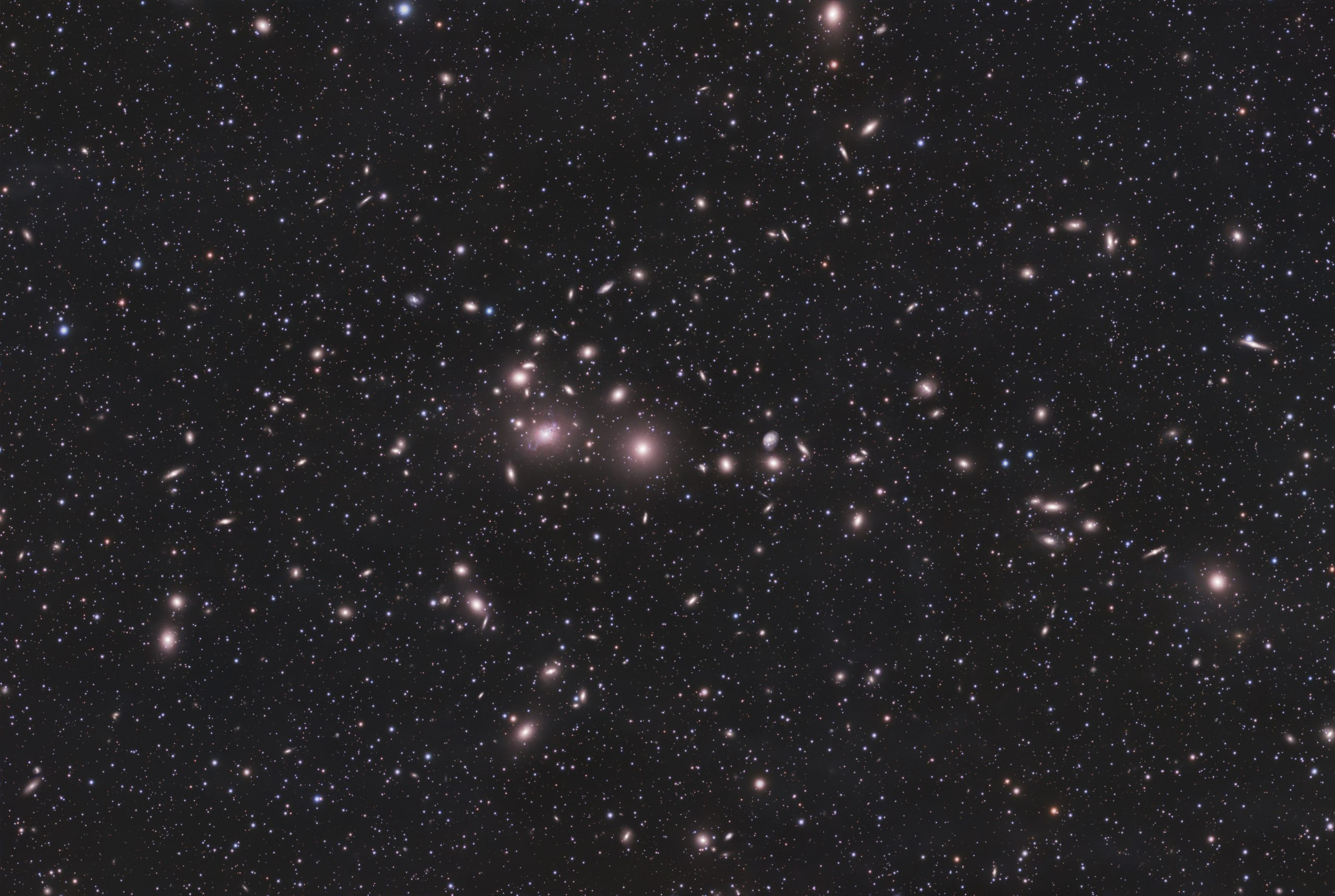
The Perseus Galaxy Cluster, also known as Abell 426, is among the largest and most massive known galaxy clusters in the universe, located in the constellation Perseus about 240–250 million light-years from Earth. This cluster contains thousands of galaxies, including prominent members like NGC 1275, which is a giant elliptical galaxy at its center.
Structure and Composition
- The Perseus Cluster spans over 11 million light-years and contains thousands of galaxies, both large and small, alongside a vast cloud of extremely hot, X-ray-emitting gas.
- It contains vast amounts of dark matter, which is crucial to its formation and structure as shown by gravitational lensing studies.
- At its core, NGC 1275 is a powerhouse of radio emission (known as 3C 84) and is associated with spectacular radio bubbles expanding into the surrounding X-ray gas.
- The cluster is embedded in a cloud of superheated gas, some of which forms bright loops, ripples, and jet-like features seen in X-ray images.
Notable Phenomena
- The Perseus Cluster is renowned for being the brightest galaxy cluster observable in the X-ray band, which makes it a key target for X-ray astronomy.
- It exhibits dramatic cosmic phenomena, such as enormous waves of hot gas caused by interactions and mergers with smaller clusters.
- Astronomers have detected giant waves spanning hundreds of thousands of light-years, believed to result from the cluster’s dynamic history of galactic mergers.
- The cluster features a faint, diffuse glow of intra-cluster light—starlight from stars torn out of galaxies by gravitational interactions—which is distinct from the central galaxy itself.
Scientific Importance
- Due to its size and proximity, the Perseus Cluster is one of the most thoroughly studied clusters for understanding galactic evolution, dark matter, and the behavior of hot intracluster gas.
- Observations of its central galaxy, NGC 1275, provide insight into the role of active galactic nuclei in heating the surrounding intracluster medium and in shaping the cluster environment.
- Studies using the Euclid space telescope and other observatories have revealed more about the mass distribution, dark matter content, and evolutionary history of this cluster.
The Perseus Galaxy Cluster is a cornerstone in both observational and theoretical astrophysics, offering key clues about galaxy formation and large-scale cosmic structure.
