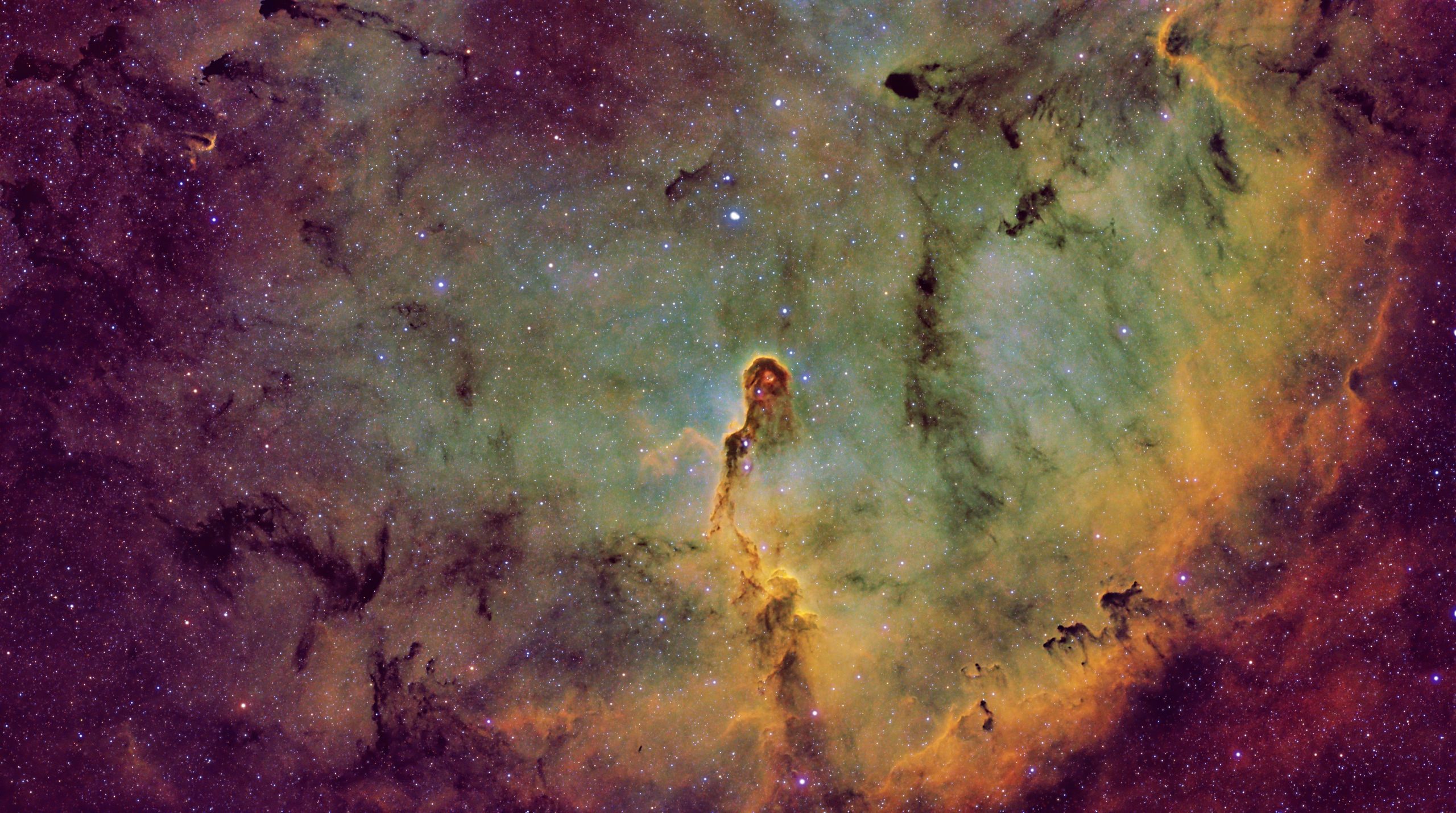
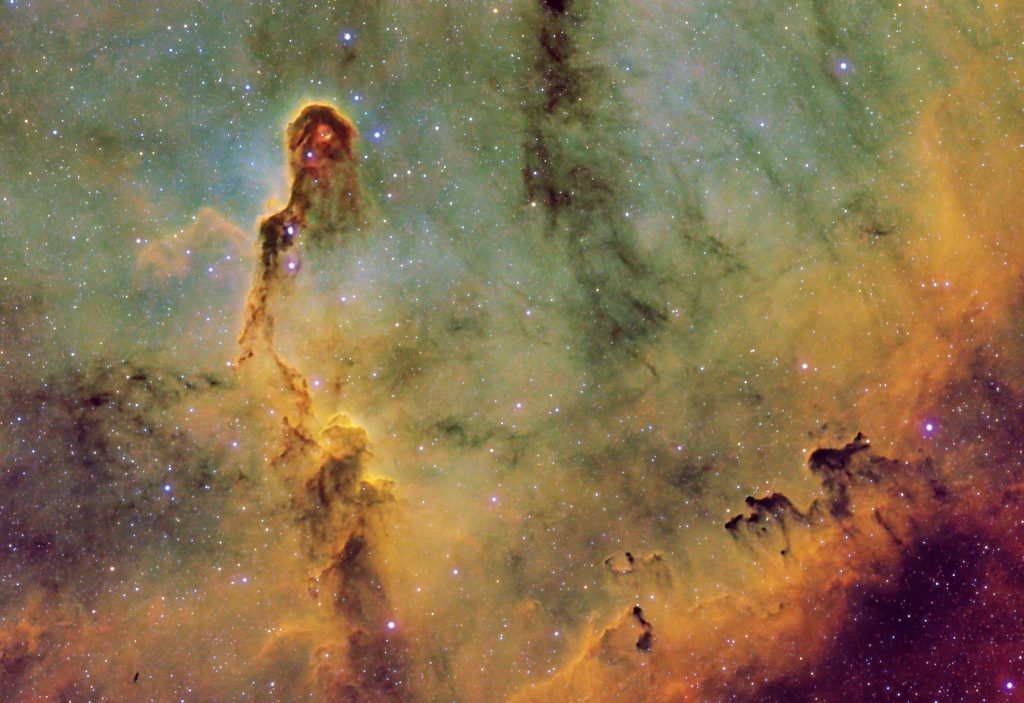
IC 1396A also known as the Elephant trunk captured with a RedCat 51 and a QHYMini8Cam Mono on an iOptron HEM27ec unguided. 180s sub frames 60 x Ha, 50 x Sir and 50 x OIII controlled with Stellarmate.
The Elephant Trunk Nebula is a striking region of interstellar gas and dust, known for its star formation activity and distinctive dark, sinuous structure that resembles an elephant’s trunk at visible wavelengths.
Overview and Location
- The nebula is designated IC 1396A and is part of the much larger IC 1396 emission nebula complex in the constellation Cepheus, approximately 2,400 light-years from Earth.
- Its elongated, trunk-like appearance is easily recognizable in astrophotography and is a popular target for both amateur and professional astronomers.
Physical Characteristics
- The Elephant Trunk spans about 20 light-years in length and is comprised of cold interstellar dust and gas, which blocks background starlight and forms its characteristic silhouette.
- The nebular complex is illuminated and shaped by intense radiation and stellar winds from a nearby massive O-type star, HD 206267, which ionizes and compresses the surrounding gas.
- Its integrated magnitude is about 5.6, making it a challenging object to observe visually; it appears as a faint patch even in dark skies.
Star Formation and Activity
The Spitzer Space Telescope has identified numerous hidden protostars within its dense clouds.
The Elephant Trunk Nebula is a rich site of active star formation, containing over
250 young stars, many under 100,000 years old. Some protostars have been revealed by infrared imaging.
The pressure from the massive star’s ultraviolet radiation and winds from emerging stars trigger compression in the nebula, creating conditions for new stars to form.
Star Formation and Activity
- The Elephant Trunk Nebula is a rich site of active star formation, containing over 250 young stars, many under 100,000 years old. Some protostars have been revealed by infrared imaging.
- The pressure from the massive star’s ultraviolet radiation and winds from emerging stars trigger compression in the nebula, creating conditions for new stars to form.
- The Spitzer Space Telescope has identified numerous hidden protostars within its dense clouds.
Observing and Astrophotography
- It’s located near Mu Cephei (Herschel’s Garnet Star) in Cepheus, making it relatively simple to find with star charts or telescope navigation aids.
- Narrowband filters and long-exposure astrophotography reveal its colorful and detailed structure, particularly the glowing rim where ionized gases meet cold dust.
Catalog Identifications
Scientific Interest
- The nebula is a textbook example of how the interplay between massive stars and molecular clouds drives star formation and shapes the landscape of the interstellar medium.
The Elephant Trunk Nebula remains a fascinating target for scientific study and astrophotography, illustrating the ongoing cycle of star birth and the dynamic processes shaping our galaxy.
